
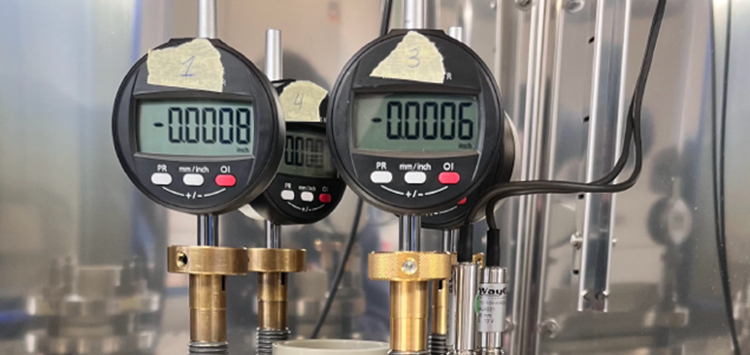
Design of the used measurement cell (Bild: University of applied sciences Münster)
26.10.2026 A PQR-based approach to creep- dependent design of thermoplastic flange joints
Method of an EN 1591-1 oriented calculation
Thermoplastic flange joints are increasingly used in corrosive service but exhibit pronounced viscoelastic creep, leading to a time-dependent loss of bolt preload and gasket surface pressure. Existing analytical standards such as EN 1591-1 neglect creep of thermoplastic collars and are therefore insufficient for reliable tightness assessment. This work extends the PQR concept by determining individual and combined creep relaxation factors for gaskets and thermoplastic collars through component- and system level experiments. The results show strong dependencies on material, temperature, load, geometry and time and demonstrate that simple multiplicative approaches are inadequate. The proposed method enables an EN 1591-1 oriented calculation with improved prediction of surface pressure loss and defined applicability limits.
Introduction and limitations of existing design methods for thermoplastic flange systems
Thermoplastic materials exhibit significantly more pronounced creep behavior compared to metallic materials such as steel. Under constant load, this time-dependent deformation leads to a continuous reduction of bolt force in flange connections. As a consequence, the gasket surface pressure decreases over time and may fall below the minimum required level for tightness. In such cases, leakage can occur.
The current state of the art analytical design method for bolted flange connections is defined in DIN EN 1591-1 [1]. This approach does not account for the time-dependent material behavior of flange components, particularly the creep of thermoplastic collars. The method is primarily based on elastic assumptions for metallic flanges. Time-dependent effects are only considered for the gasket material by means of the creep relaxation factor (PQR), which is determined experimentally according to DIN EN 13555 [2]. While this approach is suitable for describing the relaxation behavior of gaskets, it does not capture the additional creep-induced deformation of thermoplastic flange components.
Lösungspartner
